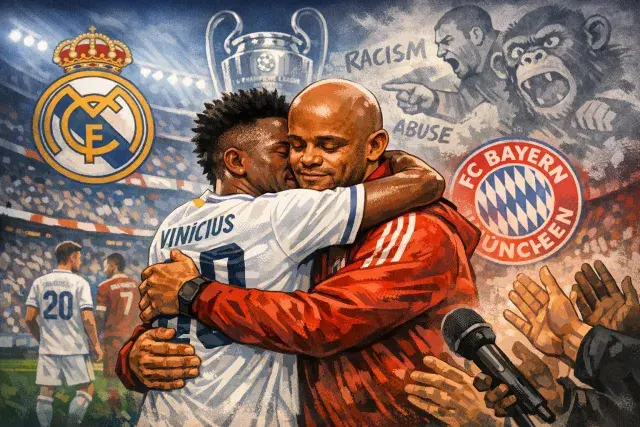
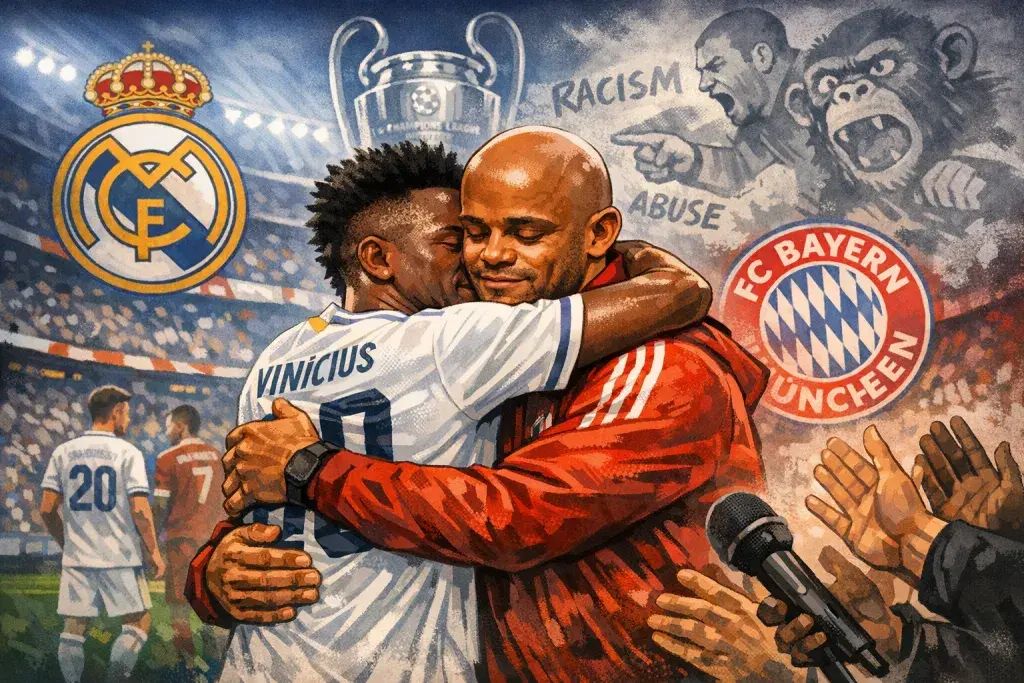
A brief exchange between two figures from rival camps during the interval of a UEFA Champions League quarter-final encounter between Real Madrid and Bayern Munich carried a weight far exceeding its duration. Vinícius Júnior approached Vincent Kompany, extended a high five, and pulled the Bayern Munich head into a hug before returning to his side. The moment was not spontaneous warmth between old acquaintances — it was, by Kompany's own account, their first meeting in person, and it was rooted in something far more serious than sporting rivalry.
The Incident That Made the Gesture Necessary
The context begins with a Champions League playoff fixture in which Vinícius Júnior publicly accused Benfica winger Gianluca Prestianni of directing racist abuse toward him. The allegation ignited a familiar and painful debate within European football's governing structures and in the broader public conversation about racism in professional sport. What distinguished the aftermath was not the allegation itself — Vinícius has faced racist incidents with troubling regularity throughout his career — but the response it drew from figures outside his own club.
Kompany, a Belgian-born son of Congolese parents who built his own career partly on the strength of his public identity and principles, condemned the incident directly and unequivocally. He did not hedge. He did not resort to the diplomatic equivocation that institutional figures in professional sport so often deploy when racism surfaces. His condemnation was clear enough that Vinícius took note — and chose to acknowledge it in person at the earliest opportunity.
What Public Solidarity Actually Costs — and Why It Matters
Speaking out on racism in a professional environment carries real risk, particularly for those in positions of institutional authority. Heads of professional sides navigate relationships with governing bodies, sponsors, club boards, and media ecosystems that reward caution. A figure in Kompany's position who chooses to name racism directly — rather than appeal to vague notions of respect or fairness — exposes himself to friction with multiple stakeholders simultaneously.
This is precisely why Vinícius's gesture carried meaning. The hug was not diplomatic theatre. It was a private acknowledgment, made in a semi-public moment, that Kompany's words had landed and were understood as costly. Kompany, for his part, confirmed the encounter after the final whistle and articulated his position with care: football, he indicated, benefits from personalities who are willing to express themselves fully, but criticism of those personalities must never cross ethical lines. That formulation — separating legitimate critique from racially motivated abuse — is not as widely shared in European football's leadership as it should be.
Racism in European Football: A Structural Problem, Not a Series of Incidents
Vinícius Júnior is not the first — and is unlikely to be the last — Black professional in European football to endure racist treatment and then face secondary debates about whether his response to it was appropriate. The pattern is well-documented and deeply frustrating: the person subjected to abuse often finds themselves subjected to additional scrutiny about tone, conduct, or proportionality, while the perpetrator receives comparatively muted attention.
What the Prestianni incident and Kompany's response illuminate is the gap between institutional statements and individual accountability. Governing bodies routinely issue condemnations of racist incidents. What is rarer is a respected individual — one with authority, visibility, and something to lose — choosing to speak without qualification. When that does happen, it registers differently, both for the person who was targeted and for the wider culture of the profession.
The hug between Vinícius and Kompany lasted seconds. What it represented was an acknowledgment that meaningful allyship — not performative solidarity, but the kind that requires someone to accept friction and speak plainly — still exists, and still matters to those who need it most.